

Preventing and Treating Split Ends: A 3-part series. Part 1
Written by Julane Falknor
Hey Sis! Happy New Year! It is January, the month of fresh starts, new planners, and, let’s be real, the month where we finally look at our ends and realize we’ve been ignoring them since the summer.
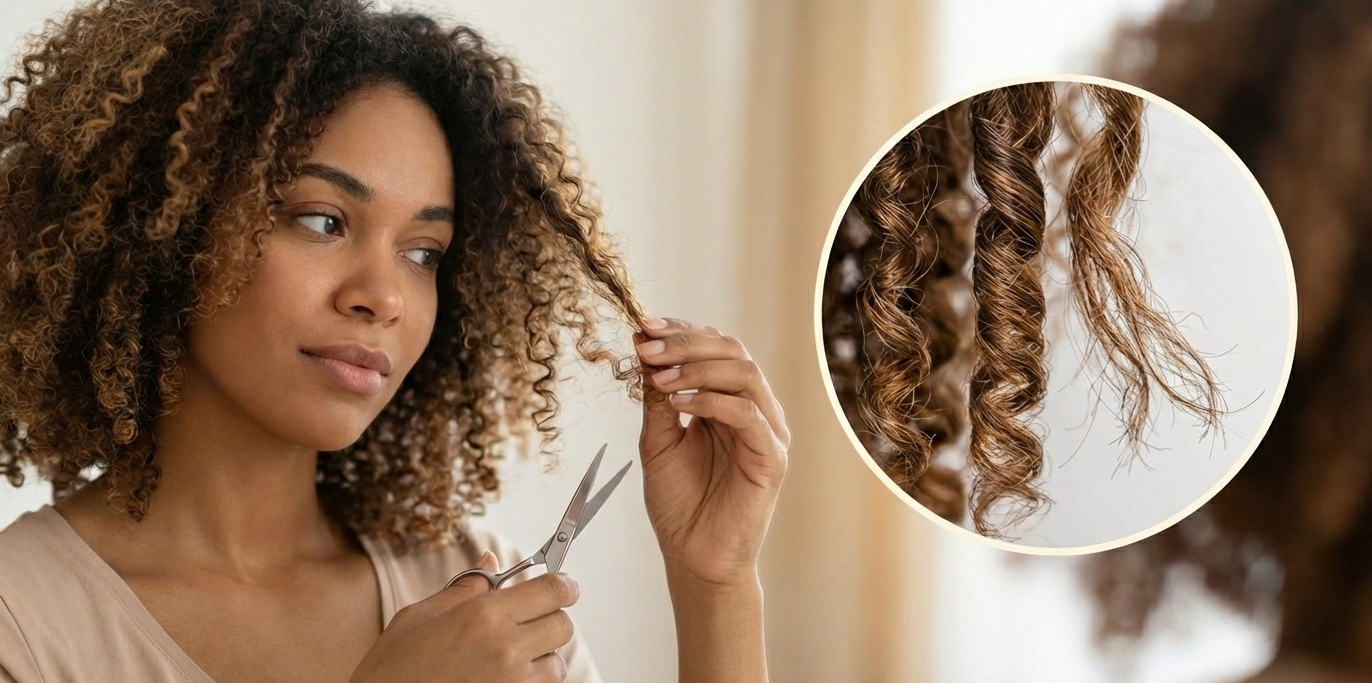
Welcome to the ultimate StyldLife Crown Club deep dive. Consider this our official "state of the union" for your strands. We’ve all been there: you’re doing your length check, feeling yourself, and then you see it, that tiny, frayed "Y" at the bottom of your favorite curl. Then you see another. And another. Before you know it, you’re spiraling on Google at 2 AM, wondering if you can glue them back together (Spoiler: You can’t, but we’ll get to that).
Listen, your crown is your glory, but those split ends? They are the silent thieves of length and confidence. This guide is going to be your roadmap to smoother, stronger hair. We’re not just talking surface-level tips; we’re going into the science, the technique, and the mindset shift you need to make 2026 your year of zero-breakage.

The Ultimate Guide: Table of Contents
Introduction: Why the "January Reset" Starts at Your Ends
Section 1: The Anatomy of a Split – The Science of the Strand
Understanding the Cuticle, Cortex, and Medulla
Why Kinks, Coils, and Curls are Naturally Vulnerable
The Different "Types" of Split Ends (Yes, there are more than one!)
Section 2: The Silent Killers – Identifying Your Damage Profile
Mechanical Damage: The Friction Factor
Heat Damage: When "Just One Pass" Goes Wrong
Chemical & Environmental Stressors
Section 3: The Prevention Blueprint – Building Your Daily Defense
The "Moisture-First" Philosophy
Detangling Without Destruction
The Role of Nighttime Care: Silk, Satin, and Self-Love
Section 4: The Art of the Cut – Dusting vs. Trimming
The "Search and Destroy" Method
How to Know When It’s Time to Let Go
Section 5: Advanced Treatment – Managing Existing Splits
The Myth of "Mending" Products
Deep Conditioning and Bond Builders
Section 6: The StyldLife Way – Expert Routines & Styles
Protective Styling for End Preservation
Section 7: Frequently Asked Questions (Ask Us Anything!)
Section 1: The Anatomy of a Split – The Science of the Strand
Alright Sis, let’s put on our lab coats for a second. To beat the enemy, you have to understand how it’s built.
Each hair on your head is a complex structure. Think of your hair strand like a high-end designer rope. At the center, you have the Medulla (the core), surrounded by the Cortex (where the strength and color live), and all of it is wrapped in the Cuticle. The cuticle is made of tiny, overlapping scales, kind of like shingles on a roof.
In a perfect world, those shingles lie flat, trapping moisture inside and making your hair look shiny. But here is the tea: Curly hair is naturally disadvantaged. Because our hair grows in spirals, kinks, and coils, those cuticle scales are constantly being lifted at every turn and bend of the curl. This makes it incredibly easy for moisture to escape and for the "shingles" to get snagged and broken.
Why the Ends?
Your ends are the oldest part of your hair. If your hair is shoulder-length, those ends have been on this earth for two, maybe three years. They’ve seen every wash day, every failed braid-out, every scarf, every humid summer, and every freezing winter. By the time they get to this age, the cuticle is naturally thinner.
The Different Faces of Split Ends
Not all splits are created equal! If you look closely at your hair (maybe with a magnifying mirror and a prayer), you might see:

The Traditional Split: The basic "Y" shape. This is the beginning of the end, literally.
The Tree Split: Multiple splits branching off one side. This means the cortical fibers are seriously exposed.
The Single Strand Knot (Fairytale Knots): While not technically a split, these lead to splits when you try to comb through them. Our Crown Club expert Aevin Dugas has spoken at length in our webinars about how these knots are the bane of the naturalista’s existence!
The Incomplete Split: The hair is split in the middle but still attached at the tip. This creates a "hole" in the strand that eventually snaps.
StyldLife Insight: If you’re noticing these types of damage, don't sweat it. Our community is built on learning. If you missed our "Science of the Strand" deep dive with Yanine Williams, you definitely want to check that out in our network library—she breaks down product chemistry in a way that makes so much sense for our texture.
Section 2: The Silent Killers – Identifying Your Damage Profile
Before we can treat your hair, we have to figure out how we got here. Most of us aren't intentionally hurting our hair, but "silent killers" are everywhere.
1. Mechanical Damage: The Friction Factor
This is the most common cause for naturalistas. Every time your hair rubs against a cotton pillowcase, a wool coat, or even your own shoulders, tiny bits of the cuticle are chipped away.
The Towel Trap: Rubbing your hair with a standard terry cloth towel is like rubbing it with sandpaper.

The Accessory Attack: Those hair ties with the metal bits? Throw them away, Sis. They are literally guillotines for your curls.
2. Heat Damage: The "Just This Once" Lie
We love a good silk press or a quick blow-dry to stretch for a style. But heat changes the protein structure of your hair. Once you've "cooked" the protein (keratin) in your hair, it becomes brittle. Brittle hair doesn't bend; it snaps.
3. The Winter Woes (January Special)
Since we’re sitting here in January, we have to talk about the air. It’s dry outside and the heaters are blasting inside. This sucks every last drop of moisture out of your hair. As our resident pro Erikajoy mentioned in her "Winter Hair Heroes" webinar, if your hair feels like straw, your ends are going to split like wood.
Pro-Tip from the Club: Whenever you’re wearing those cute winter sweaters, try to wear your hair up. The friction between your ends and that wool scarf is a recipe for a "Search and Destroy" mission later! If you need help mastering an elegant updo that keeps your ends tucked away, the Tiffany Reid bridal and special occasion webinar has some stunning looks that work perfectly for everyday "end protection."
Section 3: The Prevention Blueprint – Building Your Daily Defense
Prevention is the only "cure" for split ends that actually works. You can’t fix a split, but you can stop it from starting. Here is your StyldLife-approved daily defense strategy.
1. The "Moisture-First" Philosophy (L.C.O or L.O.C)
You’ve heard it before, but are you doing it? Your ends need the most love. When applying your leave-in, cream, or oil, start at the ends and work your way up. We often do the opposite, slathering the roots and letting the ends catch the leftovers. Flip the script, Sis! Your roots have the benefit of natural scalp oils (sebum); your ends are starving.
2. Detangling: The Sacred Ritual
Listen to me: Never detangle in a rush. If you have 5 minutes to get out the door, that is not the time to tackle a knot.
Finger Detangle First: Use your "human tools" to feel for knots.
Slippery Slope: Never detangle dry hair. Use a product with massive "slip." If you're struggling to find the right product for your specific coil type, our Crown Club network has an entire database of product recommendations tailored to your hair's porosity.
Bottom to Top: It sounds basic, but start at the ends. If you start at the root, you’re just pushing all the tangles down into a giant, knotted "boss fight" at the bottom of your strand.
3. The Nighttime Sanctuary
If you aren't sleeping on silk or satin, we need to have a heart-to-heart. Cotton is a "thirsty" fabric, it absorbs the moisture right out of your hair while you sleep. A silk bonnet or pillowcase allows your hair to glide. It’s a small investment for a massive payoff. Think of it as insurance for your crown.
4. Protective Styling: The Tucked-Away Secret
The best way to prevent split ends? Keep the ends away from the world. Styles like mini-twists, buns, or even those gorgeous "bubble braids" we featured in our recent shoot are perfect. They keep the hair contained and the ends hydrated.
Expert Integration: In our webinar with Cynthia Ohonsi, she emphasized that even for our little ones, building a routine of "tucking the ends" early on is the key to length retention. If you're managing a busy schedule and need a routine that doesn't take 4 hours, Cynthia’s "Safe Regimen" guide on our network is a lifesaver.
Sis, we’re just getting started! We’ve covered the "why" and the "how-to-stop-it," but coming up next, we’re going to talk about the actual "surgery"—how to trim your hair without losing your mind, and the truth about those "split end mender" products.